Showing posts with label Surname Saturday. Show all posts

Saturday, June 07, 2014

Surname Saturday: Tomelin

Luchenia Demosky
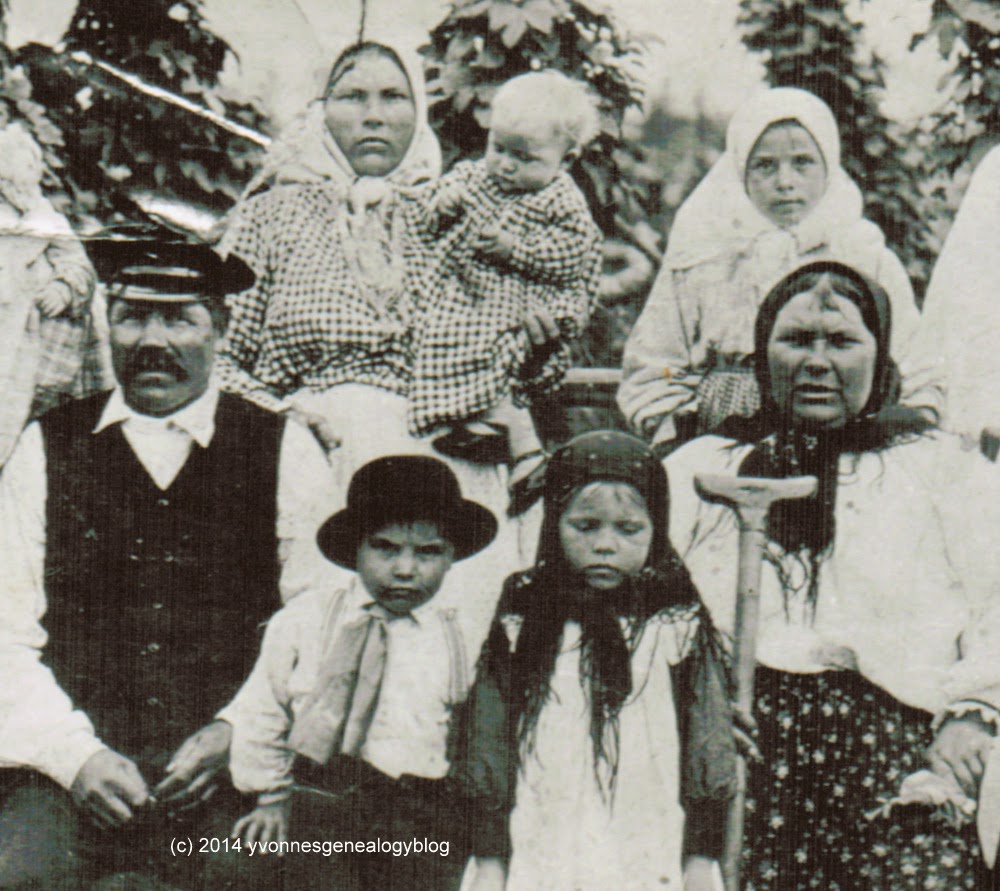
Luchenia (Tomelin) Demosky, centre, holding her son George, with her parents 
Nick and Maria (Terichow) Tomelin, sitting, about 1912.

My husband’s paternal grandmother was Luchenia Tomelin (1885-1960).

Luchenia, sometimes known as Lukeria or Lucy, was born in 1885 in the Russian Empire. As a young teenager, she, her parents, siblings and close relatives immigrated to Canada from Russia in 1899, travelling on the S.S. Lake Huron. [1] I recently wrote about this experience here.

The standard spelling for Tomelin is Tomilin. English spelling variations include Tamelin, Tameelin, Tamilin, Tomelin, and Tomlin. [2]

Tomilin is a patronymic surname, derived from Tomila, a man’s name. [3]

According to the Doukhobor Genealogy Website, Doukhobors surnamed Tomilin “originated from the province of Tambov, Russia in the 18th century”. [4]

By 1905 in Canada, Tomilin families lived in Doukhobor villages in the South Colony in Kamsack District, the Good Spirit Lake Annex in Buchanan District, and the Blaine Lake District in Saskatchewan District, all in the province of Saskatchewan. [5]

Sources:

1. “Passenger Lists for the Port of Quebec City, 1865-1900”, digital images, Library and Archives Canada (http://www.bac-lac.gc.ca/eng/discover/immigration/immigration-records/passenger-lists/passenger-lists-quebec-port-1865-1900/Pages/introduction.aspx : accessed 28 March 2014), manifest, S.S. Lake Huron, 21 June 1899, p. 24 (penned), entry no. 1445, Lukeria Tomilin [sic], age 13.

2. “Origin and Meaning of Doukhobor Surnames”, Doukhobor Genealogy Website (http://www.doukhobor.org/Surnames.htm : accessed 2 June 2014), entry for Tomilin.

3. “Origin and Meaning of Doukhobor Surnames”, Doukhobor Genealogy Website, entry for Tomilin.

4. “Origin and Meaning of Doukhobor Surnames”, Doukhobor Genealogy Website, entry for Tomilin.

5. “Village-Surname Index for the 1905 Doukhobor Census”, Doukhobor Genealogy Website (http://www.doukhobor.org/SK-Villages-Families.htm : accessed 2 June 2014).

Copyright © 2014, Yvonne Demoskoff.

Saturday, April 12, 2014

Surname Saturday: Poznekoff

Polly Cazakoff and Wasyl Poznekoff
Polly (Poznekoff) Cazakoff with her brother Wasyl Poznekoff

My husband’s maternal grandmother was Polya (Polly) Poznekoff (1887-1971), wife of George Cazakoff. I recently wrote about her here.

Polly was about 12 years old when her widowed father Iwan (John) Poznekoff, and her brothers and sisters immigrated to Canada in 1899.

The surname Poznekoff is the English spelling for Poznyakov or Pozdnyakov. It originates from the word poznii or pozdnii, which means “late”. [1]

According to the Doukhobor Genealogy Website, there were “two unrelated branches of Pozdniakovs among the Doukhobors” in the 18th century living in the Russian provinces of Sloboda-Ukraine (Kharkov) and Tambov. [2]

By 1905 in Canada, most Poznikoff families lived in what was known as the North Colony in Doukhobor-established settlements surrounding Arran, Saskatchewan. [3]

Today, Poznekoff is one of the most common Doukhobor surnames in Canada. [4] English spelling variations include Pozdnekoff, Poznikoff, Pozney and Poznikow. [5]

Poznekoff should not be confused with Postnikoff, a similar-sounding Russian (Doukhobor) surname.

Sources:

1. “Origin and Meaning of Doukhobor Surnames”, Doukhobor Genealogy Website (http://www.doukhobor.org/Surnames.htm : accessed 20 March 2014), entry for Pozdnyakov.

2. “Origin and Meaning of Doukhobor Surnames”, Doukhobor Genealogy Website, entry for Pozdnyakov.

3. “Village-Surname Index for the 1905 Doukhobor Census”, Doukhobor Genealogy Website (http://www.doukhobor.org/SK-Villages-Families.htm : accessed 20 March 2014).

4. “Guide to Doukhobor Names and Naming Practices”, Doukhobor Genealogy Website (http://www.doukhobor.org/Guidenames.htm : accessed 20 March 2014).

5. “Origin and Meaning of Doukhobor Surnames”, Doukhobor Genealogy Website, entry for Pozdnyakov.

Copyright © 2014, Yvonne Demoskoff.

Saturday, November 30, 2013

Surname Saturday: Prosper (formerly Desgroseilliers)


My mother's maiden name is Desgroseilliers. She’s a 9th generation descendant of Médard Chouart, sieur des Groseilliers. (See my post Médard Chouart, sieur des Groseilliers.) I've been researching my Mom’s paternal ancestors for as long as I can remember, and always assumed that many of sieur des Groseilliers’ descendants through his only surviving (legitimate) daughter Marie-Antoinette Chouart were surnamed Desgroseilliers or a spelling variation of that name.

However, genealogy research throws curve balls at you every so often. A few years ago, I found out that some of sieur des Groseilliers’ descendants took the Christian name ‘Prosper’ and turned it into their surname. As curve balls go, this one was relatively minor, but definitely interesting.

As far as I can tell, ‘Prosper’ was a first name in the Desgroseilliers family as early as 1743, when Marie-Antoinette's grandson was christened with the compound first name ‘Joseph Prosper’. [1] His surname was Dorval at birth, but he later used Bouchard and Desgroseliers.

‘Prosper’ seems to be used as a dit name for the first time when Joseph Prosper Dorval’s sons François (born in 1783) and Joseph (born in 1791) appear as ‘Desgroseilliers dit Prosper’ in some of their children’s baptism and marriage records in the mid-1830s in Châteauguay County, Quebec. For example, when François’ daughter Marie married Antoine Roy in 1834, and Joseph’s son Michel was baptised that same year, their surname was ‘Desgroseilliers dit Prosper’. [2] On other occasions during this time frame, the surname was ‘Prosper dit Desgroseilliers’. [3]

The earliest use of ‘Prosper’ as a stand-alone surname might be when Amable Desgroseilliers (son of Joseph born in 1791) married (as ‘Aimable Prospert’) Caroline Archambault in 1845 in Cooperville (now Coopersville), Clinton County, New York. [4]

Chart showing the progression of Desgroseilliers surname to Prosper

It’s a mystery to me why some of sieur des Groseilliers’ descendants in Canada and the USA chose ‘Prosper’ as a surname. The only thing I can think of is that they are from the line of Joseph Prosper Dorval. Or, could it be that ‘Prosper’ is easier to pronounce and write than ‘Desgroseilliers’?

Sources:

1. St-Joseph (Deschambault, Quebec), parish register, 1713-1791, p. 10 verso, no entry no. (1743), Joseph Prosper Dorval baptism, 19 May 1743; St-Joseph parish; digital image, “Quebec, Vital and Church Records (Drouin Collection), 1621-1967”, Ancestry.ca (http://www.ancestry.ca : accessed 24 November 2013).


2. Ste-Martine (Ste-Martine, Quebec), parish register, 1834, p. 7 verso, entry no. M.8, Roy – Desgroseilliers marriage, 10 February 1834; Ste-Martine parish; digital image, “Quebec, Vital and Church Records (Drouin Collection), 1621-1967”, Ancestry.ca (http://www.ancestry.ca : accessed 24 November 2013). Also, Ste-Martine (Ste-Martine, Quebec), parish register, 1834, p. 9 recto, entry no. B.27, Michel Desgroseilliers dit Prosper baptism, 15 February 1834; Ste-Martine parish; digital image, “Quebec, Vital and Church Records (Drouin Collection), 1621-1967”, Ancestry.ca (http://www.ancestry.ca : accessed 24 November 2013).

3. Ste-Martine (Ste-Martine, Quebec), parish register, 1835, p. 9 verso, no entry no., Dumas – Prosper marriage, 16 February 1835; Ste-Martine parish; digital image, “Quebec, Vital and Church Records (Drouin Collection), 1621-1967”, Ancestry.ca (http://www.ancestry.ca : accessed 24 November 2013).


4. St-Joseph du Corbeau (Cooperville [Coopersville], New York), parish register, 1843-1846, p. 82, no entry no. (1845), Prospert – Archambeault [sic] marriage, 10 June 1845; St-Joseph du Corbeau parish; digital image, "Early U.S. French Catholic Church Records (Drouin Collection), 1695-1954”, Ancestry.ca (http://www.ancestry.ca : accessed 24 November 2013).


Copyright © 2013, Yvonne Demoskoff.

Saturday, February 16, 2013

Surname Saturday: Cazakoff

My late mother-in-law Ann was born a Cazakoff. She was the youngest child and only daughter of George and Polly (Poznekoff) Cazakoff, Doukhobor immigrants who settled Canada in 1899. (For a brief explanation of this Russian religious group, see Family History Though the Alphabet – S is for …)

In 1948, Ann’s elder brother Philip legally changed his surname Cazakoff to the more English-sounding Casacove.

As a surname, Kazakoff developed from the word kazak, which means Cossack. According to the Doukhobor Genealogy Website, Doukhobors with the surname Kazakov “originated from the province of Tambor, Russia in the 18th century”.1

Kazakoff is one of the most common Doukhobor surnames in Canada; it ranked fourth in 1970.2 Other English spellings include Kazakow, Kozakoff, Casacove, Kazakove, Kasikoff and Kasakoff.3

Sources:

1. “Origin and Meaning of Doukhobor Surnames”, Doukhobor Genealogy Website (http://www.doukhobor.org/Surnames.htm : accessed 7 April 2009), entry for Kazakov.

2. “Origin and Meaning of Doukhobor Surnames”, Doukhobor Genealogy Website, entry for Kazakov.

3. “Origin and Meaning of Doukhobor Surnames”, Doukhobor Genealogy Website, entry for Kazakov.

Copyright © 2013, Yvonne Demoskoff.

Saturday, September 01, 2012

Surname Saturday: Demoskoff

At first glance, “Demoskoff” appears to be a Russian surname, but it didn’t start out that way. My husband Michael knew that his father was born “Demosky” and that he changed his name to “Demoskoff” during World War II. (Bill and his elder brother George changed their surname at the time of the 1940 National Registration in Canada, because as he explained, “We weren’t Polish.”)

That was all Michael knew of his name until his father paid us a visit in the 1990s. Bill liked to reminisce about his past, his childhood and his family, and he didn’t fail to do so on this trip. After supper one evening, he told us the story of his family name.

Some years previously, Bill’s brother Pete met a man who had the same name as he did – Peter Demosky. This Peter Demosky said that Pete’s surname “Demosky” was previously “Konkin”. It seemed that while in Russia, Pete’s grandfather Mikhail met an officer who told him he could avoid military conscription by changing his Russian name Konkin to that man’s Polish name Dymovsky. Being a Doukhobor and a pacifist, Mikhail took his advice.

Bill didn’t know any other details, such as the soldier’s identity, when and where the name change took place, or how this other Peter Demosky knew Mikhail. It might be difficult to prove the elements of this story, but they seem based on precedent. It was not uncommon for Doukhobors in 19th century Russia to change their surnames. For example, Doukhobor leader Savely Kapustin’s son, Vasily, was deliberately declared illegitimate at his birth and given his mother’s surname Kalmykov in order to protect him from being “automatically liable for conscription” because his father (Kapustin) had served in the army. (For more information, see “Guide to Doukhobor Names and Naming Practices” at Doukhobor Genealogy Website.)

In 1899, Mikhail and his family left Russia along with other Doukhobors who sought religious freedom in Canada. Once here, Mikhail’s surname became Demofsky, and later Demosky. Some of his descendants are Demosky, while others like his grandsons Bill and George (and their families) are Demoskoff.

Copyright © 2012, Yvonne Demoskoff

Friday, August 24, 2012

Surname Saturday: Janvry dit Belair

When I was a young girl, my Pépère Fred told me that our family name wasn’t just “Belair”; it was “Belair dit Janvry”. I didn’t understand what the ‘dit’ part meant, or why there was a ‘Janvry’. After I started doing genealogy, I learned that Janvry was our original family name and that Belair was a second last name that eventually took over Janvry.

But what about the dit portion of our name? Dit names were a common occurrence among the French soldiers who came to Canada in the 1600s and 1700s. One explanation for dit names is that a soldier received a nickname or a nom de guerre when he enlisted in the French army. François Janvry dit Belair (my first Belair ancestor in Canada) possibly acquired Belair as his soldier’s nickname or alias. (There is evidence to suggest that François’ family name was originally Dufay, not Janvry. More research, especially in primary records in France, is needed to confirm this possibility.) Nicknames added another dimension to a soldier’s identity, and were based on such criteria as his place of origin, his trade, his military past or occupation, a personal trait, or even derived from a plant or an animal. In François’ case, it's possible that his nickname referred to a personal trait (‘bel air’ can be translated as a fine or nice attitude or demeanour).

Over the centuries, Janvry was spelled in a variety of ways. For example, on François’ marriage contract in 1761, his patronym and nickname were ‘Janevri dit Belair’, while at his burial in 1817, it was simply ‘Janvry’. Other spelling variations include (in alphabetical order) Desanvry, Dejanvry, Geanvrier, Genvre, Gnvry, Janvri, Janvrie, Janvris, Janvrise, Janvry, Jeanvery, Jeanvril, and Jeanvris.

Belair, on the other hand, underwent fewer spelling variations; examples include Belaire, Bellaire and Bélair. Pépère Fred maintained that we spelled our name ‘Belair’, without an accent aigu on the ‘e’, but I don’t know if he meant just us (his family) or for all his Belair ancestors and relatives. (Other Belair families lived in Timmins when we were there, but they spelled their name ‘Bélair’. Apparently, they weren’t related to us.) During my research, I discovered additional Belair families with different origins than ours. They are the Coulon dit Bélair, Delpêche dit Bélair, and Plessis dit Bélair families.

As a family name, ‘Janvry dit Belair’ became ‘Belair dit Janvry’, then simply ‘Belair’. It wasn’t until the early 1900s that ‘Belair dit Janvry’ or ‘Janvry’ ceased to be regularly used by François’ descendants. ‘Janvry’ as a family name no longer exists; we are now all ‘Belair’.

Copyright © 2012, Yvonne Demoskoff